

Flavor Market to Reach USD 34.0 Billion by 2035 at 6.40% CAGR as Natural and Health-Focused Flavors Drive Innovation
Flavor Market
Flavor Market is projected to reach USD 34.0 billion by 2035, driven by natural ingredients, product innovation, & evolving consumer taste preferences.
Flavor is no longer just about what tastes good — it’s about what feels meaningful, personalized and future-facing.”
NEW YORK, NY, UNITED STATES, August 27, 2026 /EINPresswire.com/ -- — IFF
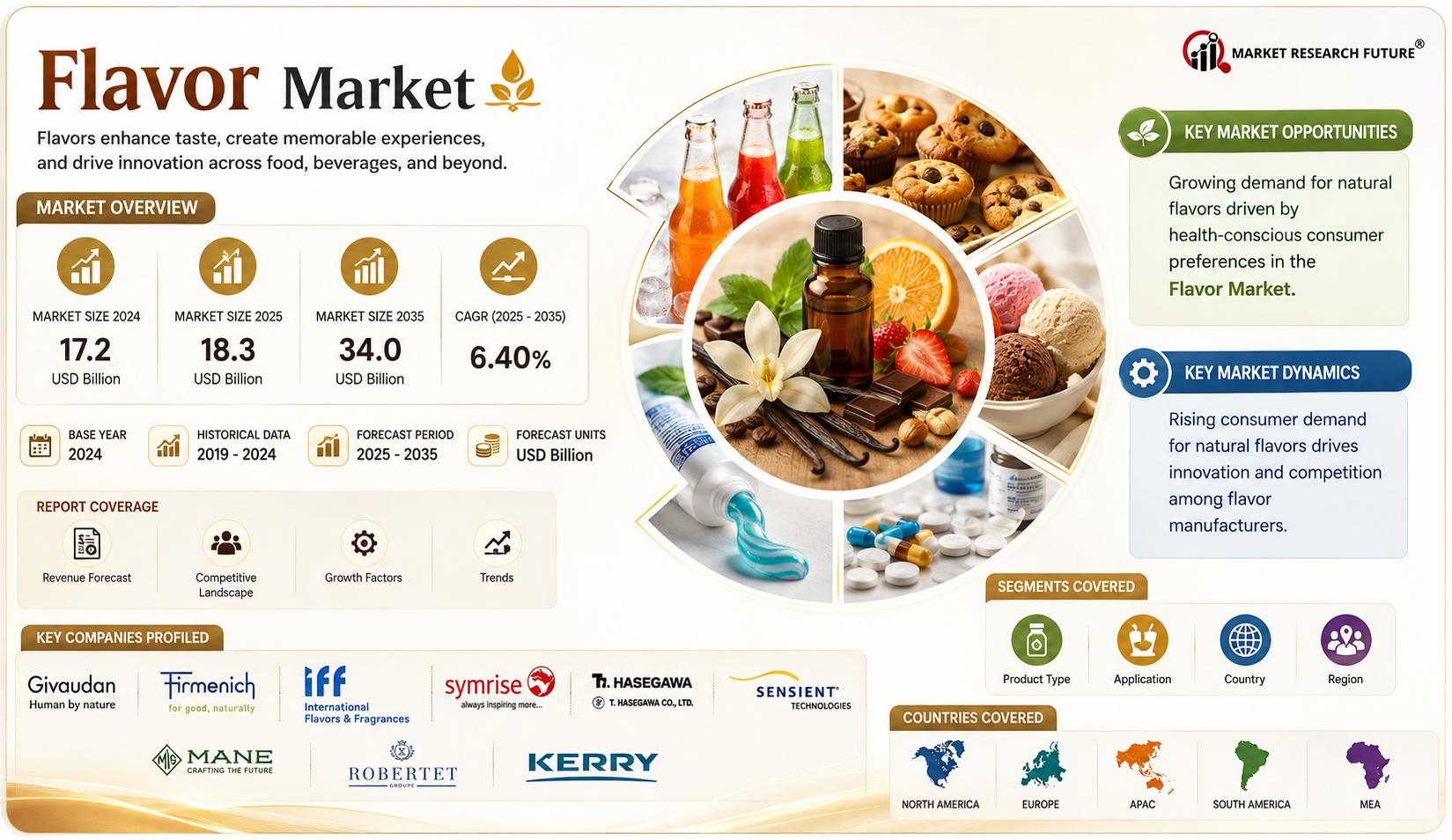
The global Flavor Market is entering a period of sustained expansion as food and beverage manufacturers increasingly use flavor systems to improve sensory appeal, differentiate products, and respond to changing consumer preferences. The market was valued at USD 17.2 billion in 2024 and is projected to reach USD 18.3 billion in 2025, ultimately reaching approximately USD 34.0 billion by 2035, expanding at a 6.40% CAGR from 2025 to 2035. The historical assessment covers 2019–2024, while the forecast period extends from 2025–2035.
The central growth factor is the increasing preference for natural flavors, particularly among health-conscious consumers seeking recognizable ingredients and cleaner-label products. At the same time, manufacturers are balancing demand for naturality with requirements for stability, consistency, affordability, shelf life, and scalable production. This is encouraging investment in botanical extracts, fermentation-derived ingredients, advanced flavor delivery systems, and sensory science. Industry innovation is also moving toward flavors that support reduced sugar, high-protein, plant-based, functional, and better-for-you formulations.
Competitive Landscape and Key Players
The competitive environment is characterized by multinational flavor and fragrance companies with extensive research capabilities, global sourcing networks, application laboratories, and established relationships with food and beverage manufacturers. Key companies profiled in the market include Givaudan (Switzerland), Firmenich (Switzerland), International Flavors & Fragrances (US), Symrise (Germany), T. Hasegawa (Japan), Sensient Technologies (US), Mane (France), Robertet (France), and Kerry Group (Ireland).
Competition increasingly centers on natural ingredient sourcing, flavor authenticity, formulation expertise, regional customization, sustainability, and speed-to-market. Major suppliers are also expanding beyond conventional flavor creation by combining sensory science with biotechnology, data-driven consumer insights, and application-specific formulation. IFF, for example, has highlighted AI-assisted formulation, personalization, regenerative ingredients, and emerging sensory experiences as important forces shaping future taste development.
Free Sample Copy - Access A Complimentary Copy of Our Report to Explore Its Content and Insights
https://www.marketresearchfuture.com/sample_request/4162
Flavor Market Growth Drivers
Natural flavor demand represents one of the most influential opportunities across the market. Consumers increasingly associate natural ingredients with transparency, wellness, authenticity, and perceived product quality. This trend is particularly important in beverages, dairy alternatives, snacks, confectionery, bakery products, and functional foods.
However, natural flavors also create technical and commercial challenges. Natural raw materials can vary according to climate, geography, harvest conditions, extraction processes, and supply availability. Flavor manufacturers therefore increasingly require advanced analytical techniques and formulation expertise to maintain consistency across production batches. Climate variability and agricultural risks are also encouraging companies to explore resilient sourcing models, alternative botanicals, fermentation, and biotechnology.
Health and wellness trends are another important demand driver. Reduced-sugar products often require sophisticated flavor modulation because removing sugar can alter sweetness perception and expose undesirable notes. Similarly, plant-based proteins may have characteristic earthy, bitter, or beany notes that require masking and balancing. Flavor suppliers therefore play a critical role in helping manufacturers create products that maintain acceptable sensory characteristics while meeting nutritional objectives.
Segment Analysis by Product Type
The product type segment can broadly include natural flavors, artificial or synthetic flavors, and nature-identical or specialty flavor systems, depending on market classification.
Natural flavors are expected to remain a major growth area because of clean-label positioning and consumer interest in recognizable ingredients. Common sources include fruits, herbs, spices, botanicals, vanilla, citrus, and other plant-derived materials.
Synthetic flavors continue to have relevance where manufacturers require cost efficiency, consistency, strong sensory impact, and reliable supply. They can provide standardized performance across large-scale production environments.
Specialty and advanced flavor systems are gaining importance as manufacturers seek customized profiles, flavor modulation, encapsulation, masking, and improved performance in challenging formulations. Bioscience-driven approaches are increasingly being used to develop flavors alongside the formulation rather than treating flavor as a final-stage addition. IFF has specifically discussed the growing role of biology, fermentation, and sensory science in dairy flavor innovation.
Segment Analysis by Application
The application segment spans a broad range of food, beverage, pharmaceutical, and other consumer products.
Beverages represent a significant area of flavor innovation because consumers frequently seek new fruit, botanical, exotic, functional, and low-sugar profiles. Carbonated drinks, energy beverages, sports drinks, flavored water, ready-to-drink products, and alcoholic and non-alcoholic beverages all require differentiated flavor systems.
Dairy and dairy alternatives use flavors to enhance products such as yogurt, ice cream, flavored milk, desserts, and plant-based alternatives. Flavor technology is especially important when manufacturers reduce sugar or formulate high-protein products.
Bakery and confectionery applications depend heavily on vanilla, chocolate, fruit, caramel, spice, nut, and other flavor profiles. Product launches frequently use flavor combinations to create differentiation and seasonal appeal.
Savory foods include soups, sauces, snacks, meat products, meat alternatives, seasonings, and ready meals. Flavor solutions can compensate for formulation changes while maintaining taste intensity and consumer acceptance.
Pharmaceutical applications use flavors primarily for taste masking and improving palatability, particularly in oral medicines, syrups, chewable products, and pediatric formulations.
Segment Analysis by Country
At the country level, market development varies according to food manufacturing capacity, consumer purchasing patterns, regulatory requirements, natural ingredient availability, and the maturity of processed-food industries.
The United States remains an important market because of its large packaged food and beverage industry, extensive product innovation, and demand for health-oriented formulations. Canada contributes through its developed food-processing sector and growing interest in clean-label products.
Across Europe, countries such as Germany, France, the United Kingdom, Italy, and Spain represent important demand centers. European consumers generally place strong emphasis on ingredient transparency, sustainability, naturality, and product quality, influencing flavor formulation strategies.
In Asia-Pacific, China, Japan, India, South Korea, and Southeast Asian markets provide significant growth opportunities. Rapid urbanization, expanding packaged-food consumption, rising disposable incomes, and regional flavor preferences are encouraging both multinational and local flavor suppliers to develop localized solutions.
Segment Analysis by Region
North America benefits from advanced food processing, high R&D intensity, and strong demand for functional, natural, and convenience-oriented foods and beverages.
Europe is strongly influenced by clean-label expectations, sustainability considerations, ingredient transparency, and regulatory developments. These factors encourage suppliers to invest in natural extracts, traceability, and formulation technologies.
Asia-Pacific is positioned as a major growth region because of its large consumer base and rapidly changing food and beverage landscape. Regional manufacturers are increasingly combining traditional flavors with contemporary product formats.
South America offers opportunities linked to agricultural resources, fruit-based ingredients, beverages, and expanding processed-food markets. Brazil and other regional economies can also support development of locally relevant flavor profiles.
Middle East & Africa (MEA) presents opportunities associated with population growth, urbanization, foodservice expansion, and demand for differentiated beverages and packaged foods. Local taste preferences create opportunities for flavors inspired by spices, fruits, herbs, and traditional culinary profiles.
Key Market Dynamics and Industry Trends
The market is increasingly shaped by the intersection of naturality, wellness, sustainability, personalization, and technological innovation. Flavor companies are moving toward more integrated solutions that combine flavor creation with ingredient functionality and formulation support.
Digital technologies are also influencing flavor development. Consumer intelligence platforms, predictive analytics, AI-assisted formulation, and sensory databases can help companies identify emerging taste preferences and accelerate product development. IFF has reported that its consumer insights work draws on more than 200,000 consumer interviews, illustrating the growing role of structured consumer intelligence in flavor innovation.
Industry Development
IFF Opens Vanilla Innovation Center in Madagascar
In May 2026, IFF announced the opening of a Vanilla Innovation Center in Madagascar, strengthening its ability to conduct science-led vanilla innovation at the source. The initiative reflects the industry's broader movement toward origin-based research, responsible sourcing, traceability, and improved resilience in natural ingredient supply chains.
IFF Advances Nature-Based Flavor and Ingredient Innovation
IFF's 2025 sustainability report, released in June 2026, highlighted continued investment in nature-based solutions, responsible sourcing, and innovation. The company reported that 77% of new products launched during 2023–2025 had a sustainability value proposition according to its internal assessment, demonstrating how sustainability is becoming increasingly integrated into product development.
Meanwhile, the competitive environment remains dynamic. Givaudan said in August 2026 that it was evaluating strategic options for its natural ingredients unit as it seeks to improve growth in its flavors business, highlighting the commercial pressure facing suppliers even as demand for natural ingredients expands.
Flavor Market Outlook
The Flavor Market is expected to maintain a positive trajectory through 2035 as manufacturers respond to consumers seeking better taste, cleaner ingredient profiles, functional benefits, and greater product variety. The projected increase from USD 18.3 billion in 2025 to USD 34.0 billion by 2035 reflects the expanding role of flavor technology across modern food and beverage development.
Natural flavors are likely to remain a central opportunity, but market leadership will increasingly depend on more than simply offering natural ingredients. Companies will need to address supply-chain resilience, consistency, sustainability, regulatory compliance, cost optimization, and application performance simultaneously. Flavor suppliers capable of combining natural sourcing with biotechnology, sensory science, digital insights, and localized formulation are positioned to compete effectively as the market evolves.
Frequently Asked Questions
1. What is driving the growth of the Flavor Market?
The primary growth drivers include rising demand for natural flavors, clean-label products, health-oriented foods and beverages, reduced-sugar formulations, product personalization, and continuous flavor innovation.
2. What will be the size of the Flavor Market by 2035?
The Flavor Market is projected to reach USD 34.0 billion by 2035, expanding at a 6.40% CAGR during 2025–2035 from an estimated USD 18.3 billion in 2025.
Market Scope
The Flavor Market report covers revenue forecasts, competitive landscape, growth factors, trends, product type, application, country, and regional analysis. The base year is 2024, with historical data covering 2019–2024 and forecasts covering 2025–2035. Market values are presented in USD billion.
Read Our Related Research Report
Food Flavors Market -
https://www.marketresearchfuture.com/reports/food-flavors-market-4502
Flavoured Butter Market -
https://www.marketresearchfuture.com/reports/flavoured-butter-market-14015
Flavoring Essence Market -
https://www.marketresearchfuture.com/reports/flavoring-essence-market-38298
Fruit Flavour Bubble Tea Market -
https://www.marketresearchfuture.com/reports/fruit-flavour-bubble-tea-market-35130
Sagar Kadam
Market Research Future
+1 628-258-0071
email us here
Legal Disclaimer:
EIN Presswire provides this news content "as is" without warranty of any kind. We do not accept any responsibility or liability for the accuracy, content, images, videos, licenses, completeness, legality, or reliability of the information contained in this article. If you have any complaints or copyright issues related to this article, kindly contact the author above.
