

Compression Therapy Market to reach USD 7.70 Billion by 2035 at 5.3% CAGR
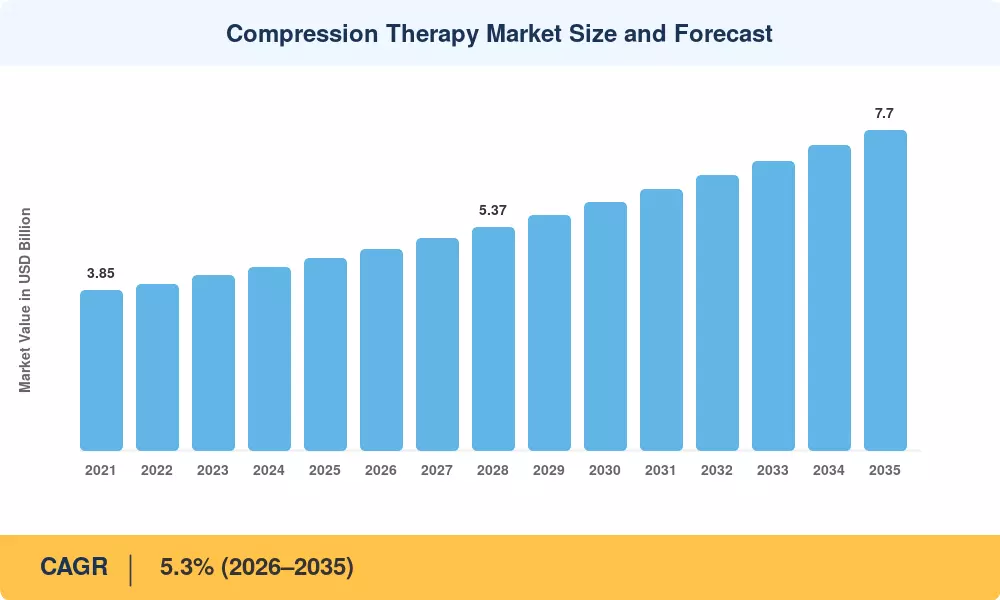
Compression Therapy Market (2026 - 2035)
Compression Therapy Market to Surge from USD 4.61 Billion in 2025 to USD 7.70 Billion by 2035—By Aging Populations and Chronic Venous Insufficiency Prevalence
NY, CA, UNITED STATES, September 9, 2026 /EINPresswire.com/ -- As per Market Research Future, the global Compression Therapy Market size is projected to reach USD 7.70 Billion by 2035 from USD 4.61 Billion in 2025, at a CAGR of 5.3% during the forecast period 2026–2035. The market base was estimated at USD 4.61 Billion in 2025, with the first year of the forecast period (2026) valued at USD 4.84 Billion.The 5.3% CAGR is propelled by three converging forces: aging populations and chronic venous insufficiency prevalence, with approximately 25% of persons in industrialized nations suffering from chronic venous illness and prevalence increasing dramatically beyond age 65, turning demographic drift into recurrent, high-visibility revenue; Medicare lymphedema benefit expansion, with the Lymphedema Treatment Act taking effect in January 2024 and unlocking Part B reimbursement for an estimated 3 million U.S. beneficiaries; and the shift of care delivery into the home, with U.S. home health agency episodes involving compression rising an estimated 18% between 2022 and 2025, favouring lightweight, patient-operable systems.
Global regulatory and reimbursement bodies are amplifying this momentum. CMS allocated over USD 1.6 billion over 10 years for lymphedema compression items under Part B, reshaping U.S. demand economics. Germany's statutory sickness funds underwrite recurring garment replacement cycles, with two to four replacements per patient annually. The European Medical Device Regulation forced a portfolio-wide recertification cycle that removed marginal suppliers and consolidated volume around scale manufacturers. North America holds 37.7% of 2025 revenue, supported by reimbursement depth and post-surgical prophylaxis protocols, while Asia-Pacific advances fastest at a 6.1% CAGR on the back of hospital construction in China and India.
Request A Free Sample:
https://www.marketresearchfuture.com/sample_request/7185
Key Market Trends & Growth Drivers
Demographic Load on Venous and Lymphatic Care
Approximately 25% of persons in industrialized nations suffer from chronic venous illness, and the prevalence increases dramatically beyond age 65. The addressable patient pool grows more quickly than overall healthcare spending, with the OECD predicting that the over-65 generation will account for 27% of the population across member states by 2035. The annual cost of bandaging and clothing replacement for each diagnosed venous ulcer patient ranges from USD 480 to USD 720, turning demographic drift into recurrent, high-visibility revenue.
Reimbursement as a Demand Switch
Clinical innovation has less of an impact on this market than coverage decisions. With CMS allocating over USD 1.6 billion over 10 years, the Lymphedema Treatment Act, which went into effect in January 2024, expanded Part B reimbursement to both daytime and nocturnal compression devices. Within two quarters, suppliers reported an increase in their order books. Similar reasoning applies to Germany's Hilfsmittelverzeichnis, which uses statutory sickness funds to pay for two to four garment replacements per patient annually.
Hospital Prophylaxis Protocols
Venous thromboembolism remains a leading cause of preventable in-hospital death, and Joint Commission surveillance metrics now track prophylaxis compliance at the procedure level. Intermittent pneumatic devices are the default for patients contraindicated for anticoagulants, which locks a consumable-plus-capital purchase pattern into surgical departments. Roughly 61% of U.S. tertiary hospitals refreshed pump fleets between 2022 and 2025.
Home Care Migration
Payers are actively relocating chronic wound and lymphedema management out of clinics. U.S. home health agency episodes involving compression rose an estimated 18% between 2022 and 2025. That migration favours lightweight, patient-operable systems with remote pressure logging, and it rewards manufacturers who can service direct-to-patient fulfilment rather than hospital tenders alone.
Ask for Customization:
https://www.marketresearchfuture.com/ask_for_customize/7185
Market Segment Insights
BY TECHNOLOGY
Static Compression Therapy: Dominant segment with 63.0% share in 2025 , reflecting entrenched clinical familiarity and low per-unit cost. Static therapy—stockings, wraps, and bandage systems—holds its position because it is cheap, prescribable by nurses, and clinically proven across decades of ulcer healing trials.
Dynamic Compression Therapy: Fastest-growing segment at 6.1% CAGR (2026–2035) , driven by programmable pressure cycling entering home settings. Dynamic systems solve mechanical reproducibility without technique variability, and growth is concentrated where reimbursement now permits at-home use.
BY PRODUCT
Compression Garments: Largest segment at USD 2.23 Billion in 2025, driven by chronic venous insufficiency and post-thrombotic syndrome. Garments dominate on volume and replacement frequency—most prescribed patients need two to four pairs annually.
Compression Pumps: Fastest-growing segment at 5.9% CAGR (2026–2035) , driven by home lymphedema management and DVT prophylaxis. Pumps dominate on revenue per patient, with home units priced between USD 1,200 and USD 4,800.
Compression Braces: Significant segment with 18.4% share in 2025 , driven by orthopaedic recovery and sports rehabilitation.
BY APPLICATION
Venous Leg Ulcers: Largest segment with 31.7% share in 2025 , driven by the highest evidence base and wound care protocols. Compression is first-line therapy, not adjunct.
Lymphedema Treatment: Fastest-growing application at 6.0% CAGR (2026–2035) , driven by coverage expansion and oncology survivorship. Patient populations are well-defined, disease is lifelong, and reimbursement has only recently caught up with clinical consensus.
Deep Vein Thrombosis Treatment: Significant segment at USD 1.13 Billion in 2025, driven by surgical prophylaxis mandates.
Varicose Veins: Significant segment with 13.5% share in 2025 , driven by post-procedural compression standard of care.
BY END USER
Hospitals: Largest segment with 38.1% share in 2025 , driven by prophylaxis protocols and surgical volumes.
Home Care: Fastest-growing segment at 6.3% CAGR (2026–2035) , driven by payer-driven care relocation and increasing use of patient-operable compression systems.
Specialty Clinics: Significant segment at USD 1.22 Billion in 2025, driven by vascular and wound care centres.
Read Detailed Insights:
https://www.marketresearchfuture.com/reports/compression-therapy-market-7185
Regional Outlook
North America — Dominant Market (~37.7% Share, 2025)
United States: Generates approximately 86.4% of North American revenue , driven by Medicare Part B lymphedema coverage. Within eighteen months of the Lymphedema Treatment Act taking effect, DME suppliers reported claim volumes rising above internal forecasts.
Canada: Contributes USD 0.16 Billion, driven by provincial assistive device programmes.
Mexico: Fastest-growing in the region at 5.8% CAGR (2026–2035) , driven by IMSS vascular clinic expansion.
Europe — Second Largest (USD 1.27 Billion, 2025)
Germany: Holds 24.1% of regional share , driven by statutory sickness fund aid schedules. Fixed aid amounts guarantee access but compress vendor margins.
United Kingdom: Contributes USD 0.19 Billion, driven by NHS lower-limb wound pathway redesign. The National Wound Care Strategy Programme estimated annual NHS spend on wound care above GBP 8.3 billion.
France: Holds 15.8% of regional share , driven by LPPR reimbursement listings.
Italy: Fastest-growing in the region at 4.9% CAGR (2026–2035) , driven by regional vascular screening programmes.
Spain: Contributes USD 0.09 Billion, driven by public hospital tender cycles.
Nordic Countries: Growing at 5.1% CAGR (2026–2035) , driven by centralised procurement and high adherence rates.
Russia: Contributes USD 0.05 Billion, driven by domestic textile substitution.
Asia-Pacific — Fastest-Growing Region (6.1% CAGR, 2026–2035)
China: Holds 33.6% of regional share , driven by tertiary hospital vascular department growth. The NMPA streamlined Class II registration for compression devices in 2023.
India: Fastest-growing in the region at 6.9% CAGR (2026–2035) , driven by Ayushman Bharat secondary-care coverage.
Japan: Contributes USD 0.24 Billion, driven by aging population and national health insurance listing.
South Korea: Holds 8.1% of regional share , driven by post-surgical prophylaxis protocols.
ASEAN: Growing at 6.4% CAGR (2026–2035) , driven by private hospital chain expansion.
South America — Growing Presence (5.6% Share, 2025)
Brazil: Anchors the region with 58.7% of revenue , driven by SUS wound care protocols and ANVISA registrations.
Argentina: Contributes USD 0.04 Billion, driven by private health plan coverage.
Middle East & Africa — Emerging Opportunity (USD 0.20 Billion, 2025)
Saudi Arabia: Holds 31.2% of regional share , driven by Vision 2030 hospital capex programme.
UAE: Contributes USD 0.05 Billion, driven by medical tourism and private hospital density.
South Africa: Fastest-growing in the region at 6.2% CAGR (2026–2035) , driven by diabetic foot ulcer prevention initiatives.
Egypt: Holds 9.8% of regional share , driven by universal health insurance rollout.
Competitive Landscape and Recent Developments
Concentration sits in the moderate band, with an estimated HHI near 900 and a top-five combined share around 44–48%. Differentiation increasingly rests on made-to-measure capability, fitter networks, and regulatory readiness under MDR rather than raw manufacturing scale.
KEY COMPANIES AND RECENT MILESTONES
Essity AB (JOBST, BSN Medical): Broadest global footprint with wound care adjacency. Ready-to-wear and custom garments, bandage systems. Estimated ~13–16% revenue share.
medi GmbH & Co. KG: Premium custom lymphology specialist with flat-knit and circular-knit garments, and donning aids. Estimated ~9–12% revenue share.
SIGVARIS Group: Fitter-network strength in NA and Europe with medical and lifestyle graduated stockings. Estimated ~7–10% revenue share.
Paul Hartmann AG: Hospital tender depth across DACH with multi-layer bandage kits and wound compression. Estimated ~6–9% revenue share.
3M / Solventum (April 2024): Completed the spin-off of its healthcare business as Solventum, giving the Coban compression franchise standalone capital allocation. Estimated ~5–8% revenue share.
ConvaTec Group PLC: Advanced wound care integration with wound and compression bandaging portfolio. Estimated ~4–7% revenue share.
Tactile Systems Technology: Home lymphedema reimbursement specialist with Flexitouch and Entre pneumatic systems. Estimated ~4–6% revenue share.
Other Key Players: Arjo AB (~3–5%), Julius Zorn GmbH (Juzo) (~3–5%), Enovis (DJO) (~2–4%), Cardinal Health (~2–4%), Bio Compression Systems (~1–3%).
Recent Industry Developments:
Centers for Medicare & Medicaid Services (January 2024): Part B reimbursement for lymphedema compression items took effect, reshaping U.S. demand economics.
National Health Service England (November 2024): Extended the National Wound Care Strategy lower-limb pathway to further integrated care boards.
Future Outlook: 2026–2035
The Compression Therapy Market is projected to reach USD 7.70 Billion by 2035, growing at a CAGR of 5.3%, driven by aging populations, Medicare lymphedema benefit expansion, and the shift of care delivery into the home.
New opportunities lie in:
Connected Pressure Verification: Devices that log applied pressure and wear duration convert an unverifiable therapy into an auditable one, positioning vendors for value-based tenders.
Emerging-Market Primary Care Entry: Localized production in Guangdong and Tamil Nadu can reduce landed costs by 22–28%, making Class 1 and Class 2 clothing affordable at out-of-pocket prices.
Recovery and Performance Channels: Athletic recovery has legitimised pneumatic compression devices with consumers who have no clinical diagnosis, generating an estimated USD 410 million globally in 2025.
Data Monetisation and Subscription Models: Manufacturers can license de-identified adherence cohorts to payers for actuarial modelling, or bundle garments into subscription replacement plans.
Post-Oncology Lymphedema Pathways: Breast cancer survivorship programmes increasingly build compression into standard follow-up, with 20–30% of axillary node dissection patients developing secondary lymphedema.
By 2035, the Compression Therapy Market is expected to demonstrate robust growth, reflecting the transformation of compression therapy from a commodity textile category into a data-enabled, home-based care platform.
More Related Research Insights:
https://www.marketresearchfuture.com/es/reports/healthcare-software-as-a-service-market-29747
https://www.marketresearchfuture.com/zh-cn/reports/healthcare-software-as-a-service-market-29747
https://www.marketresearchfuture.com/ko/reports/healthcare-software-as-a-service-market-29747
https://www.marketresearchfuture.com/fr/reports/veterinary-animal-vaccines-market-2687
https://www.marketresearchfuture.com/ja/reports/veterinary-animal-vaccines-market-2687
https://www.marketresearchfuture.com/de/reports/veterinary-animal-vaccines-market-2687
https://www.marketresearchfuture.com/fr/reports/tattoo-removal-market-1701
https://www.marketresearchfuture.com/ja/reports/tattoo-removal-market-1701
https://www.marketresearchfuture.com/de/reports/tattoo-removal-market-1701
https://www.marketresearchfuture.com/fr/reports/softgel-capsule-market-7467
Market Research Future
Market Research Future
+1 855-661-4441
email us here
Legal Disclaimer:
EIN Presswire provides this news content "as is" without warranty of any kind. We do not accept any responsibility or liability for the accuracy, content, images, videos, licenses, completeness, legality, or reliability of the information contained in this article. If you have any complaints or copyright issues related to this article, kindly contact the author above.
